How to Read This Book
This book covers every aspect of a web application, both on the web browser side (front end) and on the web server side (back end). The fundamental concepts are first presented from a theoretical point of view and then illustrated with source code examples.
The code we provide is written in Vanilla style, meaning that it does not depend on any development framework (except for the database connection, which requires a specific driver). The goal of the Vanilla approach is to gain a solid understanding of the deep mechanisms at the heart of every web application.
This book relies on a running example: building a web application that manages an image wall. The application displays a wall of images and lets users comment on or like the images they want. This running example includes the classic features found in most web applications.
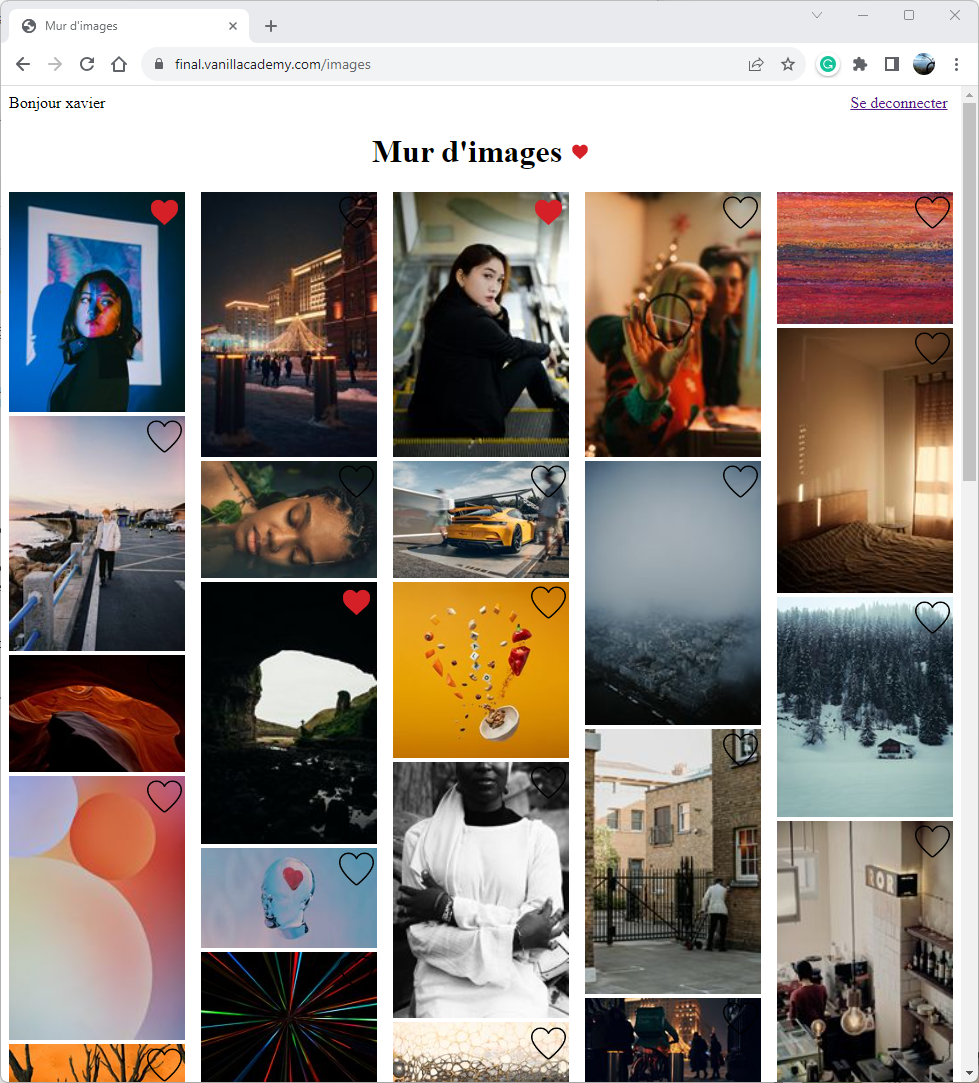
The image wall application we build in this book.
This book is intended for people who want to learn how to develop web applications, for developers who want a better understanding of the fundamental concepts of the web, for teachers who want to prepare a course on this subject (from high school to university level), for students who want an in-depth knowledge of the web, and finally for anyone who simply wants to understand web development.
This book is meant for learning. It contains exercises that will let you measure your knowledge and understanding of the web. Parts of the application's development are left as exercises so that you can get a better grasp of the issues involved in developing web applications.
This book is made up of four parts that can be read independently, even though we designed them to follow a linear progression:
- Web Pages: This part presents the fundamental concepts of the web: web server, web browser, web page, resource, the HTTP protocol, HTML and CSS. It explains how a web server works and how it delivers web pages to the browsers that request them.
- Web Server: This part describes the internal mechanisms of web servers in more detail. It explains how a web server responds to the various requests it receives from web browsers. Finally, it shows how to serve the resources that make up web pages statically, and even how to generate some of them dynamically.
- Databases: This part explains the role of databases in a web application. It describes why databases matter, with a focus on relational databases. Finally, it explains how the web server and the database are connected.
- Front-Back Interaction: This part presents the mechanisms for handling user interactions. It explains how to use JavaScript in the browser to modify web pages and handle user events. Finally, it describes web sessions, cookies and how to set up user accounts.